Wednesday, May 17, 2006

Mute and salted


He smiled. His fine teeth seemed bleached against his dark skin, dark as the chengal boards cladding the shops on the side streets of Kuala Besut.

“My ah-kong’s ah-kong’s ah-kong’s ah-kong… That’s how long we’ve been here,” replied Chengal Dude lightheartedly in Mandarin, a language I’m alien. He seemed to be in his early 30s, well-toned, chiseled, sharp-eyed. He was maybe a guide, a pro-diver at Perhentian Islands, we couldn’t tell.

Names, existing terms, fail to describe the man. You may say he is Chinese as I am, but the seasons under the salted sun of Terengganu has bronzed him to the point anyone would mistake him for a Malay.

You may say Chengal Dude is a peranakan of the East Coast, a people less publicized than the Baba-Nyonyas of Melaka or Penang, but no less present. They’ve been around this place for a long time. Chengal Dude is unmistakably a true son of the land, speaks the loghat without ponder or pause, reads the Malay papers, wears the mannerisms of the locals to the subtlest levels. That’s because this culture is his culture; his people contributed to it no less. The Hokkien he shares with the coffeeshop owner is so thick with its own inflections and phrases – a loghat in its own right – you’d miss what was being said. Chengal Dude is Sino-Malay-Siam-Javanese forged by the monsoon winds, ground by the fine sand of its beaches.

There is yet an appropriate name to describe all this.


Records about early settlements in the East Coast are relatively thin, still more fuzzy than pinpoint. Its people are believed to have migrated from Indochina and southern China but the prevailing culture today stems from Java. There are accounts of the expansive kingdom of Langkasuka which reigned in the Isthmus of Kra. Excerpts from a 5th century Chinese script makes reference to a place called Ho-Lo-Tan where a thriving settlement existed.

Who were these people? More importantly, who are they now? There is a very high chance integration occurred on a fairly large scale, a mongrel breed that evades current definitions of race. They are a monsoon tribe who rightfully pwn this land. This time of the year, their sky is blue and their breeze fresh and still unsullied by the corporate pheromones of Guess?, MNG nor Nike.

This is a piscean landscape. They dig fish here. Fish - fresh or seawater - is eaten whole, diced, sliced, fillet, fried, boiled, satayed, grilled. It is processed into a dozen different types of keropok – keropok losong, keropok lekor – and this wonderful conical lump of fish paste called satah. At Kota Bahru’s central market, your eyes pop at the variety of fish sauce available.

And even as we marvel at the cultural peculiarities, the language, the muara settlements, the pregnant storm clouds, the shape of roofs, the friendlier eyes, we learn to draw lessons seldom discussed in west coast circles.
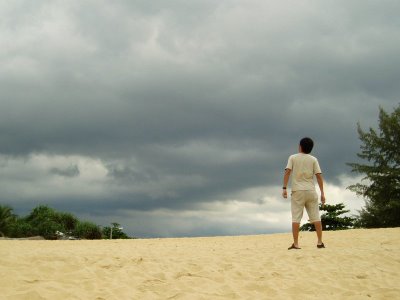

Here again is a lesser-told story of mainland Malaysia – the role of geography in shaping culture. The Titiwangsa Range, rumbling like a dragon from the Ismuth of Kra, wedges the peninsular flatlands apart, creating a jungle curtain practically impenetrable until recently that the East and the West coasts of mainland Malaysia culturally evolved on parallel paths.

If the west coast was about Sumatra and SriVijaya and the Melaka Sultanate, the east was Java and Majapahit and Siam. (Besut, for instance, is a Thai derivative which means Land of Far Away) This gets increasingly evident as one travels northwards along the east coast.

For this was where colonial influence was least – hence less tempered – again thanks to the physical barriers of Titiwangsa. The Portuguese and Dutch waived it, the British had only a token presence, thinning out as the main mountain range thickened up north. The east coast states of Kelantan, Terengganu and Pahang are today a living resource of how things operated without the economic allure of the Straits and tradewinds and without the open-house policy of the British East India that was concentrated more on the west.

The land did not experience the full impact of the population boom, nor the divide-and-rule politics until recently. Rather like a gang of moored perahus, it bobbed and rolled along a slower, more organic development pattern.


Current terms fail to capture what one senses. Rumah doesn’t capture the essence of an east coast dwelling, it sounds wrong; waktu senja is too flaccid for the raging coastal sunset, pasir is ridiculously out of place. Perhaps it’s just personal, but I dare say much of our local Malay nouns evoke a Straits-Sumatran sheen. I feel like a mute.

Malaya, now Malaysia, is a country defined and shaped by the British colonists, just as India and Burma. There is geographical wholeness to it although the region of Sabah and Sarawak is clearly based on political allegiance rather than geology. Within our shores are pockets and folds of cultural dialects each unique to its geography and history. The east coast is but one. As the country rifles through the 21st century, it is our task to nourish and sustain these diverse patterns that exist in the many enclaves.

Pray Putrajaya has the wisdom to opt away from a mono-Malaysia. The east coast – like Sabah and Sarawak, like hill towns and coastal towns, like muara towns and hulu kampongs – has to be allowed the faith to grow in its own imagination, locked genuinely to its current patterns and practices.

If a west coast Bandar boy would take the trouble to see, he would see a lot. Yeo and I did that. On the Buddhist holiest full moon of Wesak, a period revering Gautama’s search and eventual understanding, we too set on a search and came out understanding a little more about our land and who we are.

We entered from the drylands of Jelebu – onto the riverine settlements of Temerloh, onto Kuantan and Kuala Terengganu and Kota Bahru, through lemang land, keropok coasts, and nira fields, through the oil refineries of Kerteh, into the womb of the Penarik lagoon, kissed the shoulder of the Thai-Malaysian border – and emerged through the very, very wet rain scoop that is the East-West Highway.


In that little pilgrimage we are reaffirmed that our land is beautiful, yet raised from a viewpoint heavily slanted towards the west, we are clipped in tongue to describe its being. In a land where elements of Malay, Java, south China, and Indochina are pounded on a monsoon pestle, marinated with the spice of time, we can only taste so well its flavour but not describe it with due justice. Our language falls short.

Chengal Dude doesn’t fret.

“Oh, Ko’lompor…” he mutters when we tell him where we’re from, makes a smirk on his lips and a slight shrug of his shoulders. In not so many words, it said – Orang Bandar, you who seek escalators and aircon, perched in 30-storey tiled concrete boxes, wear jackets and gowns to dinners, jump to synthesized beats and throbbing lights, of course, you’re mute.

P.S. For material that speak more than a thousand words, pls see http://www.aiyeo.net/?p=64

Tuesday, May 09, 2006

The water margin

Here’s a bad dream. Imagine you're on a boat leading to Venice, its hull cutting the lapping waves silently. Your palms sweat in anticipation of the experience ahead. Then your eyes pop.

Straight ahead, newer buildings – some very tall, some faux-botteghe types – present themselves as lighthouses to a 'revitalized' Veneto region. The ferryman pulls over to dock at a spanking new harbour; you know, one of those blob designs with plenty of glass and steel.

Try as you might, you cannot see the historic Lido beachfront. The original Lido of Lidos, nature’s gateway to the Venetian archipelago. You ask the ferryman. “Oh, that’s another 3km inland,” he replies fluently in the international language you speak. “We are on reclaimed land. Progress, man. Economics.”

“All this, from here around to Murano and one-third of the Canale di San Marco is now terra firma. New, new, all new! It is good. You can walk to the Piazza San Marco now. No floods, no smells. Massage? You like entertainment? Shopping?”


******

Wake up.

That’s not Venice, can never be Venice. Despite its shortage of land, despite the annual floods, despite the obvious sanitation problems, Venice wrestles with these issues but treasures its heritage above all. Its history has been meticulously recorded by scholars, simplified to pop level for tourists, and continues to be spun. Artists, musicians and writers reach for its essence. Italo Calvino alluded to it in Invisible Cities, Joseph Brodsky in Watermark. Venice remains a living pearl, ever-growing layer by layer and never subsumed.

No, that’s not Venice. Wake up, wake up to reality.

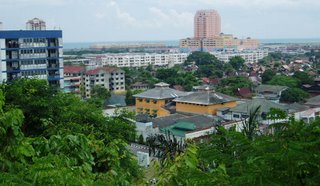
That’s Melaka. Beautiful Melaka – arguably the most important seaport this side of the world in the 15-19th century, seat of an empire that stretched from Acheh to Riau, and land of a hundred cultures. Beautiful but vain. And in its vanity, turning ugly.

The story of Melaka is a vivid tale which can only be told from the point of a water’s edge. It is Gita Bayu - a settlement carved from the tradewinds. It was a truly global city in its time and, in that context, rivaled by few – not in Europe, not the Far East. For here, the twain did meet.

It was on this sandy margin where Parameswara, the Sumatran prince, fleeing from the ghosts of his testosterone, arrived by sea perhaps in a gang of perahus. He made it his estate and named it after a tree. The man knew his PR, I guess. In time, Melaka grew as a seaport where merchants from Arab, India, Siam, China and the surrounding islands steered in, rested and traded. Silk must been unfurled, camphor and sandalwood burned, ceramicware stacked on shelves, jade traded alongside jaspers. I imagine the air was thick with the scent of spices, the ground coloured from their spills. And the music and languages and food.

It was on this margin legends of the Malay warrior were born. Perhaps they trained and meditated near the rocky escarpment at Tanjung Kling, perhaps at a gelanggang by the river, we’ve yet to know.

It was on this margin the Ming Dynasty Admiral Cheng Ho moored during his Imperial expeditions in the 1400s. Melaka was more than a pitstop for the 300 ships that comprised his enormous armada. It was the warm quarters of a good friend, a place to strengthen the body and spirit before the next leg.

It was this margin, whose real estate was so valuable, Europe just had to own it. The Portuguese snatched it over blood, then the Dutch, then the British, in a game of musical chairs lasting almost five centuries. A fort rose out of the laterite; a town grew from inside and around it. Bridges crossed the river. Brick structures began replacing wood construction. Churches, temples and mosques were built. Schools too, along with other institutional buildings.

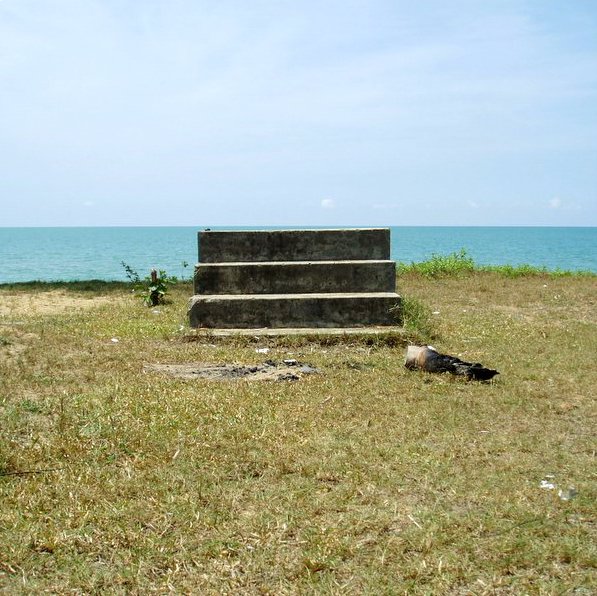
On Feb 20, 1956, Tunku Abdul Rahman fresh from a successful mission in London, announced at Bandar Hilir’s Dataran Pahlawan that the Merdeka Agreement had been signed. We shall be free, the Tunku promised at the park by the water; and indeed a year later we were.

The Water Margin – old Melaka’s real-life storybook. By the 1980s, it was gone. In a frenzied, ill-informed move, the government allowed land reclamation right onto the richest page of Malaysia’s history. For me, this devastating decision is akin to the burning of libraries in many civilizations past.

Today, at the Bandar Hilir side is the reclaimed Melaka Raya, pushing the shoreline a further 3km out. Beneath it, on the original sea bed are artifacts and stories, an actual maritime museum of Chinese junks, perahus, Dutch and Portuguese ships forever entombed under sand and rock that supports Mahkota Parade today.

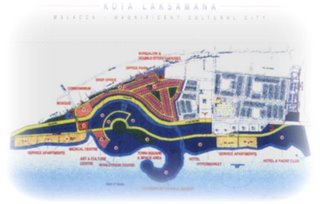
It happened in my lifetime. I remember as a kid being on a family trip to Melaka. It must have been the mid-70s before Saturday Night Fever. A Formosa was a stroll away from the water’s edge as St Paul’s Hill rose up quite suddenly. Melaka’s tip was essentially a promontory. Its layout made sense. There is an organic logic to its settlement pattern. Behind Tranquerah was the sea. Shops such as the row where the Baba Hotel is today had backs that reached over water. In the mornings, servants of these dwellings would open trapdoors and walked down ladders to boats bearing fish and vegetables. The market floated to your backdoor. Today it is Taman Kota Laksamana, a housing area like any other in any Malaysian town.

Just great. Visionary idea. A++.

Why so? Did it meet with resistance? Is Melaka so land-strapped it has to resort to such foolish, short-sighted moves? I cannot find the answer nor can I accept it.

The nightmare continues today.

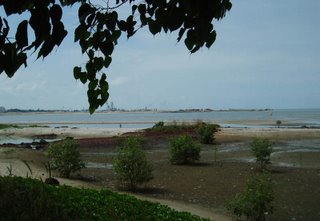
Land reclamation is proceeding northwards along the Klebang coast. The pattern is clear. About 3km away from town, a signboard on hoarding is up with an Evora Business Park announcing some oncoming paradise of offices. In time to come, tall buildings will obscure your view of the sea as you drive along the Klebang coastal road. You would have forgotten that it was here fishermen mingled with the rich, sharing a smoke and a prize catch together. Never mind that further up, Tanjung Kling was a vibrant Malay settlement in its time. That may be defaced as well, artificially pushed inland by land reclamation. In the scale of local economics, history is cheap, the senses only rewarded to those who can pay.

They made the same mistake with Port Dickson; miles of beachfront have been converted to resorts and denied public access. The drive from Port Dickson town along the Teluk Kemang coastal road was once a great treat to the senses. Today, a wall of private hotels and service apartments block that view. In what was once a perfect weekend laze-about amongst idyllic casuarinas is now a pay-per-view commodity. Port Dickson failed its people.

Please, not Melaka. This isn’t renaissance. True progress embraces history, soars on its currents, never suffocating it.

In the not too distant future, the people could plausibly appreciate – why, demand to know – Melaka’s larger history, for instance its sister relationship with Muar of which another Portuguese fort once stood. Conceivably, boutique hotels will occupy the present Dutch houses in Muar and boat cruises will ply this historic route offering a different view of the water margin. Pagoh, Batu Pahat, and Alor Gajah are awaiting a true masterstroke which can release the latent spirit of this locale and return it to a renewed vigour. All it takes is sensitivity and a little imagination.


Melaka is a settlement carved from the tradewinds. Like Venice, like Goa. For the tales yet uncovered, for respect of history, for heritage and for commonsense, Melaka’s coastal aura must remain. Remove that and you remove its soul.

Wednesday, April 26, 2006

Breathing Nusantara


It strikes you before too long. You peer around, near and afar, along the main roads and alleys. You move from urban to rural to urban again, but it’s scarce. It’s just not easy finding a clump of lallang when in Central Java. Land gets no spare change here.

The earth is constantly worked, rejuvenated and reworked; sawah padi, sugarcane fields, rivers, parit, settlements in the form of cities, shanties and villages. Just about every square inch matters in this contiguous weave of human activity and nature.

I spent four days in Central Java and merely brushed its beautiful lashes. Central Java, as sopan as they come, intoxicates with its quintessential cycles. You feel it in your bones. You smell it in the air after the rain. The rivers murmur ancient stories from the deep ravines they carved in time’s bed.

In the rice-fields, the mud basins bear generations of paddy in different stages of growth. In one segment you see tanned stalks of grain, in the next they are merely saplings. Irrigation must have enabled this capacity for year-round planting. The sawah is everywhere; it comes right up to the road shoulder, wraps around houses and courtyards, punctuates vacant plots in urban Yogya, and sweeps for miles terrace upon terrace towards the mountainous folds.

Every few years or so, the active volcanoes in the region take turns to burp. Sometimes it’s a mild clearing of the throat. Sometimes it erupts. Gunong Merapi, 35km from Yogyakarta, is next. Volcanologists say it’s a sure thing. In fear and trembling, in reverence, the locals await the episode. It is a good thing, they know. The rich organic payload from volcanoes such as Gunong Merapi have for centuries churned their land, renewing it with freshness. It is like spring. It is the hand of Lord Siva – with destruction comes rebirth. The cycle will continue.

Coupled with predictable rainfall and graced with gentle slopes which rise suddenly into mountains, it begins to explain why Central Java has played host to some of the oldest civilizations in the region and is today one of the most populous regions in the world. The Java Man (Homo erectus) was found at Sangiran. He is believed to be 700,000 years old.

Dynasties made their seat here as well. Sailendra, Majapahit, Mataram, it’s a long list with deep knowledge and technology. Just about the time they were building the earlier temples of the Khmer Empire at Roluos, east of Angkor (circa 877-889), the Buddhists in Central Java had completed their magnum opus, Borobudur (750-842).


Preah Ko and Lolei of the Roluos group of temples were built from clay bricks and local stucco; Borobudur, on the other hand is a ten-terrace temple constructed of stone complete with sophisticated strategies for stormwater drainage in the form of gargoyles. About 50 km east, the Hindus too did their testament in stone with the temple complex of Prambanan.

All these finished between the 8th and 9th centuries. That’s mind-boggling. Something in your head spins when the bus passes through the town of Magelang. It is a pretty town, saddled between two mountain ranges, distinctly Javanese where the buildings are constructed of masonry walls rather than the wooden kampong archetypes we are familiar with in Malaysia. There are street banners everywhere. Seems that Magelang is celebrating its anniversary. The banners read: Selamat Menyambut Harijadi Magelang Ke 1100.

That takes a while to register – 1,100 years of continued inhabitation is a long, long time. Here in babyland Petaling Jaya, people such as my sister comment that the SS2 neighborhood is old. This ought to give her some perspective.


The story of Central Java is an intricate tikar of a hundred stories, a Ramayana in its own right. Millions have laid their prints on its ever-churning soil leaving behind their bones and spirit – from the Java Man, through the great Sailendra and Majapahit dynasties, through the arrival of Admiral Cheng Ho’s fleet in Semarang, through the wave of Islam at Demak, through the Dutch VOC, through the Japanese Occupation, through the writings of Pramoedya Ananta Toer to the bechak riders of Malioboro Street today.

I spent four days in Central Java and peeked at only a passage of its Earth Sutra. I do not understand it, cannot grasp its dimension, but I feel it. I feel deeply about it.

Wednesday, December 28, 2005

In time, to come

“Sad flower, forced open.” I was reading in bed when I came upon those words the first time. It was a drizzly winter's morning in Oregon. No birds, they’d flown south, just cold, wet and grey. I keeled over. I sucked in deep. Four words, forty thousand watts of juice, and another forty thousand more miles of learning how to see.

Juan Ramon Jimenez’s elegant line leans towards grief and lost potential. It speaks of the tragedy when a work – any work – is not given its due process, when forced gestation leads to failed gestalt. Lost potential. How true, oh how true. The Spanish Poet Laureate doesn’t condescend, just sadly, firmly observes. And to me, it exudes a steadfast resolve that the creative act must pick and peel all plausible options before it is deemed right. Pick and peel every step of the way.

Juan Ramon’s aphorism also reaffirms my deep disdain for the faster-faster culture we’re so accustomed here in Malaysia. As if the hallmark of creativity is how fast you can churn out a pretty drawing. Or how swift you cut and paste. Wait, what about depth, what about how it fits society, what about its growth? Aiyah, whaffor we tokk RnD - no market, waste time, waste money; that one let Mat Salleh people do, let Japanese do. You faster-faster.

The result? Our landscape festers with sad flowers. From our transport system to malls to entire townships to high-rise apartments, you come across fields and fields of sad flowers. It alienates our Being. That's largely because the people who are in the driver's seat and can make a difference refuse to make that difference. After all, they learned real quick that flowers aren't currency, cash is.

Design is hard work. It teases you like a bully, mocks your intelligence, kicks sand in your face, and disappears when you think you’ve finally made a true friend. I hate it yet I can’t live without it. I avoid it, give it the cold shoulder and yet I return to it.

Design is hard because it is ultimately simple. As a haiku is simple. As E=mc2 is simple. As a calligrapher’s stroke is simple. As a courtyard is simple. Simple and far-reaching. Far-reaching and simple. Resonant, paced like a heart-beat, dark as a waterfall at night, eternal as love.

Embodied in every truly simple nugget is that door Elegance, which opens to a world of relationships and runs deep – through it, you see and feel. It is seldom dressed in pin-stripes. It isn’t pretty, it is beautiful. That same door, sturdy and true, belies the pains, questions, thoughts and feelings, contemplation, experiences bitter and sweet that a person necessarily goes through before reaching silence. If ever.

To truly approach design, it asks one thing from you: Be naked.

Then, be prepared to walk. Walk a lot. Goethe wrote: “Do not hurry. Do not rest.”

The design process is an uncharted trail that brings one to meadows and fresh springs, and dank abysses so foul you tremble at its walls. You tumble because you cannot see, rats gnaw at your ankle, and worse, you see yourself in the mirror. But you remember the moonlight, and you go on. You remember the hardness of rock, the whipping of lallang on a breezy day, and your four-year-old sister’s toothy smile after she pulled out her first earthworm.

And you want to soak in all this, pack it in a brown paper bag and share it with your neighbour. That’s easier said than done. I’ve never come across a person I respected as a designer who has said design is easy. Never.

The artist Giacometti wrote in a letter: “… I don’t understand it, but that’s how it is. I see my sculptures before me; each one…a failure. Right, a failure. But in each there’s something of what I want to create someday.”

I’ve heard many who claim to be designers say design is so easy, but that’s another story about another tribe. A tribe whose moral compass points unerringly towards the spire of cash registers and whose idea of design is a two-minute flip through a pretty magazine and pasting post-it notes over somebody's published work.

As for me, I’m learning - there's forty thousand more miles of learning how to see, much less design. The walk will be long, no doubt. And I'll fall and there will be scabs. But there are friends, kindred spirits to my left and right and we'll chug along riding on the coals of hope that someday, we’d get to gaze at flowers nurtured right - blooming in their full glory - arrived at without hurry, without rest.